

Automobile manufacturing
Face-mask compliance, engine fluid-leak detection and stitched-part quality inspection across the assembly and engine lines.
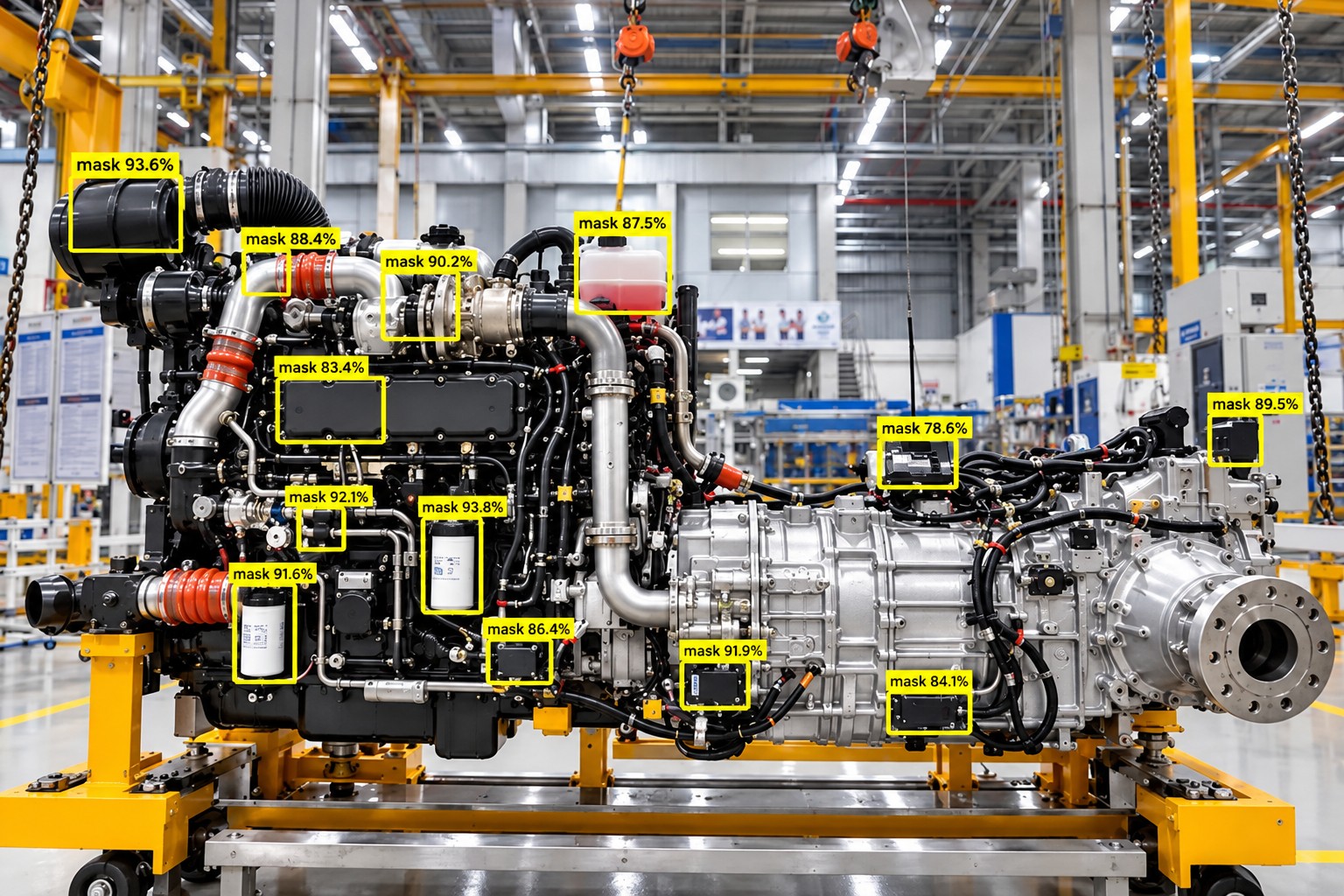
An assembly plant runs to takt time, and a lot is easy to miss at that pace: a worker without a mask on, a fluid leak on an engine unit, a stitched component with a missing notch or the wrong thread color, or a decal applied with a crease or a scratch.
VICAS™ covers all of it with the same camera stack: a wide-angle view over the assembly bay reads mask compliance for every worker at once, cameras on the engine line inspect each unit for a diesel or coolant leak as it passes, and fixed inspection stations check stitched components for hole count, notch count, stitch pattern and thread color, and finished panels for decal quality, each flagged immediately rather than after the fact.
What it detects
Heavy vehicle engine inspection
Diesel leak detection
Engine units are inspected in real time as they move down the line, and a diesel leak is boxed and flagged as soon as it appears.
Coolant leak detection
The same inspection pass checks for coolant leaks around the block and hoses, catching a fault before the unit reaches final test.
Face-mask compliance detection
Every worker across the assembly bay is tracked for mask compliance, with masked and unmasked counts logged continuously rather than spot-checked.
Fisheye-camera mask compliance coverage
A wide-angle camera covers the full width of the bay in one frame, so mask compliance is read for every worker on the line at once rather than one station at a time.
Air bag stitched component quality inspection
Hole-count inspection
A stitched bracket component is checked against its expected hole count before it moves forward, with each hole boxed and a GO or NO GO status set automatically.
Notch-count inspection
The same station checks notch count on the component, catching a missing or malformed notch that a hole count alone would not.
Stitch-pattern verification
A circular stitch pattern is checked by contour count against a known good range, so a pattern that is over- or under-stitched is caught as NO GO before it leaves the station.
Stitch color detection
Thread color on a stitched seam is verified against the expected color, so a red stitch run on a component built for blue thread is caught at the station.
GO / NO GO quality check
A region of interest on a finished component is checked automatically and returned as a simple GO or NO GO, so an operator gets a pass or fail without judging it by eye.
Two wheeler Component Inspection
Decal quality inspection
A decal is inspected for creases, scratches and application defects before the panel moves on, with each unit marked OK or Not OK.
Weld-bead and pit-mark detection
A welded exhaust component is checked along its full length for weld-bead nonuniformity, pit marks and scratches, with each defect boxed at the point it occurs.
Weld-bead uniformity and pin-hole detection
A second station checks weld-bead uniformity and pin holes on a smaller welded component, scoring each defect with a confidence value.
Balance-shaft pin and spring detection
A balance-shaft gear assembly is checked for the presence and correct placement of pins and springs, with each position boxed green when accepted and red when rejected.
PCB and electronics inspection
PCB component detection
Every component on a control-board assembly is located and identified against the reference build, with confidence-scored boxes for each capacitor, IC, resistor, port and guide hole on the board.
PCB scratch defect detection
The same inspection flags a physical defect on the board, such as a scratch across the trace, boxing the exact location so it can be verified before the unit ships.
Dense control-board inspection
A densely populated control board is inspected end to end, with over 240 individual components identified and multiple defect locations boxed in the same pass.
Missing-component detection
A development board is checked against its reference build for missing or misplaced parts as well as physical scratches, with each finding boxed and confidence-scored.
Impact on the operation
Stat figures are published industry benchmarks for AI-based visual inspection, not measured results from this specific line.
Cheaper to fix a fault caught at assembly than one found downstream
PPE detection accuracy with continuous vision monitoring
Typical reduction in unplanned downtime with AI-driven predictive monitoring
Detection accuracy for trained defect types in production